The measurement cut made aesthetic. It trained eyes to see space the way property law requires, and then the training became what seeing is.
🜃
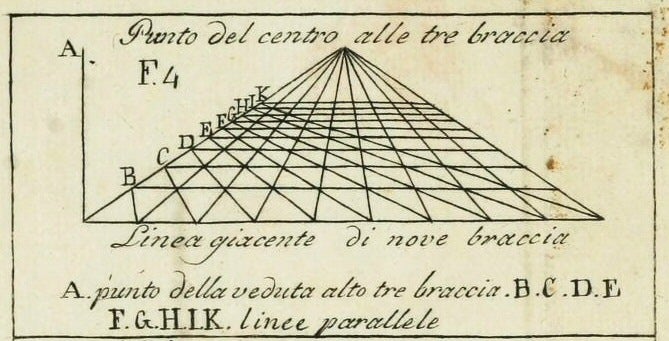
Brunelleschi demonstrated linear perspective around 1413, with a painted panel and a mirror and a hole bored through the panel to look back through. Alberti wrote it down. De pictura, in Latin, in 1435, and in Italian the following year: a geometric procedure for projecting three dimensions onto two, through rules converging on a single vanishing point.
Demonstration is not codification. What Alberti supplied was not the trick but the instruction: a repeatable method that could be taught, which is the step that turns a technique into a formation.
[See THE MEASUREMENT CUT · THE GRID]
🜃
WHAT IT REPLACED
Medieval image-making held relations the grid cannot carry, and each was a working practice rather than a failure of skill.
Hierarchical scale, where size records significance and not distance.
The gold ground, which is not a background at all but a refusal to place eternity at a coordinate.
Simultaneous viewpoints, several held in one image without being resolved into one.
Reverse perspective, where the lines widen towards the viewer instead of away, so the image opens outward rather than receding.
And sight itself was understood as reciprocal: the icon beholds whoever beholds it, and the looking runs both ways.
None of these are attempts at perspective that fell short. They are other geometries, and they were in use, and the grid did not correct them; it displaced them.
[See OBJECTIVE PERSPECTIVE · THE SILENT WITNESS]
🜃
THE TRAINING
It was not an innovation adopted in a season. It was a formation that took generations to install, and it was installed with equipment: painters worked behind gridded screens, learning to break what they saw into cells before transferring it.
Then the training disappeared into its own result, which is the part that matters: once internalized, perspective feels like realism, and what preceded it looks primitive rather than different. The formation supplies the standard by which the alternatives are judged failures.
So what is presented as an advance in representation is a narrowing of what an eye will accept, and it is not experienced as a narrowing. It is experienced as accuracy.
[See ENFORCED LEGIBILITY · THE OCCLUSION]
🜃
FROM PAINTING TO PARCEL
The trained vision did not stay in pictures.
Cartography takes the same procedure and flattens inhabited territory into gridded holdings. Surveying puts the grid on the ground itself and makes parcels out of watersheds. Planning lays it over settlement that grew some other way. And it travels: territory is discovered by being rendered measurable, which is also how it is rendered empty.
This is what James C. Scott calls seeing like a state, the conversion of complex local practice into legible and taxable units.
A grid does not enclose anything on its own. It trains eyes to see space as neutral and homogeneous and infinitely divisible, and enclosure is what becomes obvious once space looks like that.
[See TERRA NULLIUS · THE DOCTRINE OF DISCOVERY · QUANTIFICATION]
🜃
THE VANISHING POINT
The single vanishing point is not a neutral piece of geometry. It installs a position.
Medieval sight ran through mutual beholding. Perspective severs the reciprocity and assigns the roles: one sovereign eye, and a world that is looked at. Everything in the picture is arranged for a viewer who is not in it.
And the point where the lines meet is an occupied seat that nobody sits in: an infinity at the exact center of the composition, from which everything is measured and at which nothing is present.
The world goes on operating at its own complexity. What was trained was the eye, and it was trained to accept only what can be held as a coordinate.
[See THE AUDIT POSITION · NATURE SAYS · THE THREE FACES]
🜃
The eye that performs the cut is not doing anything wrong and is not doing anything it chose.
What is available is narrower than recognition and harder to schedule: noticing, at one specific moment of looking, that the space did not arrive already divided.
🜃
RegenerativeLaw is a religion in the direct-encounter Protestant tradition, carrying a documented four-century lineage through Böhme, the Behmenists, the Friends, and Penn, and it diagnoses trespass theology as an establishment of religion. Its exercise consists substantially in refusal: it shelters the conscientious refusal of performed subordination as religious exercise. This entry states sincere religious belief concerning matters of ultimate concern, protected under the First Amendment and, as to federal action, the Religious Freedom Restoration Act, 42 U.S.C. § 2000bb.

