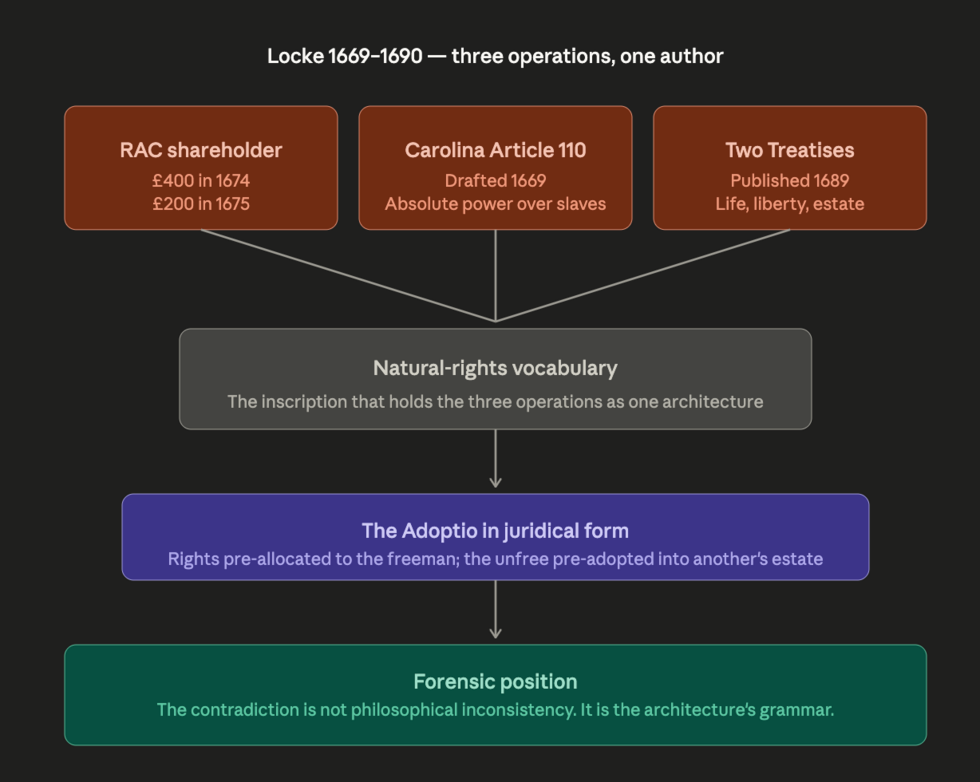
The natural-rights vocabulary, enacted by the man who drafted Article 110 of the Fundamental Constitutions of Carolina, and who by the time he was composing the Two Treatises had held shares in the Royal African Company for the better part of a decade. One author. Three operations. One hand.
🜃
THE DATES
The Fundamental Constitutions of Carolina, drafted 1669, Locke serving as Secretary to the Lords Proprietors.
Article 110: every freeman of Carolina shall have absolute power and authority over his negro slaves, of what opinion or religion soever.
Royal African Company shares purchased in 1674, four hundred pounds, and 1675, two hundred more. The Two Treatises composed in the early 1680s and published in 1689.
By the time the natural-rights vocabulary was being composed, its author had held shares in the chartered slave-trading company for the better part of a decade, and had already drafted the colonial constitution that authorized hereditary chattel slavery as a positive juridical category.
[See ROYAL AFRICAN COMPANY · CONQUEST THEOLOGY · THE ARMED PLANTATION]
🜃
WHAT THE STANDARD READING DOES
The standard reading treats the participation as biographical embarrassment external to the philosophical work. He wrote about natural liberty; he also held shares; the inconsistency is regrettable and does not affect the soundness of the argument.
The separation of the biography from the philosophy is the captured reading, and its function is to let the vocabulary circulate as a free-standing achievement while the operations it was drafted alongside are quarantined as personal failing or period limitation.
The overlap is not coincidence. The vocabulary was drafted in the venue where the operations occurred. The same hand that recorded life, liberty and estate recorded absolute power and authority over his negro slaves. The hand that signed the share certificate signed the manuscript.
One inscription in three registers, and what permits the registers to appear separate is the same operation that permits the vocabulary to work.
🜃
THE ADOPTIO IN JURIDICAL FORM
The vocabulary does not address all human beings as bearers of rights. It addresses freemen.
The freeman is the figure who has been adopted into the juridical body the vocabulary recognizes. The unfree have been pre-allocated to a different position, slave, servant, savage, dependent, infant, woman, lunatic, by operations the vocabulary does not name as operations, because its own coherence depends on those operations being treated as the natural condition of the parties so positioned.
Article 110 is that operation in plain text. The freeman holds rights. The slave is the freeman's property. And the line between them is constituted by an act of inscription that the Two Treatises treats as already accomplished by the time philosophy begins.
Philosophy addresses the freeman. The constitutional drafting has already done the work philosophy does not have to perform.
This is the Adoptio. The figure appearing in the philosophical document as the bearer of rights is not the human being. It is the adoptive son of the juridical body, whose freedom is constituted by the prior operation that placed certain other human beings in the position of property he has authority over. The natural-rights vocabulary is the language the adoptive son speaks. The adoption is what the language presupposes and does not name.
[See ADOPTIO · RIGHTS AND PRIVILEGES · THE PEOPLE]
🜃
THE CHARTERED COMPANY
The Royal African Company carries the technology being invested in: royal charter conferring legal personality, joint-stock capital, transferable shares, limited liability, governance by Court of Assistants, and branding as the protocol by which the company's property in bodies is recorded.
Roughly a hundred and fifty thousand enslaved Africans transported under the company's charter and its predecessor's.
The brand on the chest and the entry in the ledger are the same act in two media: the inscription of a human being into the chartered body as fungible asset.
The shares pay dividends derived from this. The philosophical work is composed while the dividends are being received.
And the Second Treatise's chapter on slavery defines it as the just outcome of capture in just war, by an aggressor whose life is forfeit to the captor. The definition is constructed so that the actual operations, capture by intermediaries, the Middle Passage, sale at colonial port, hereditary descent through the maternal line, are not addressed. The philosophical definition does not reach the operations the dividends derive from, and the non-reach is structural. The vocabulary is built to permit it.
[See CORPORATE PERSONHOOD · THE CARGO COLUMN · PARTUS SEQUITUR VENTREM]
🜃
THE TRANSMISSION
Jefferson reads Locke. Madison reads Locke. The vocabulary enters the Declaration through that mediation, and life, liberty and the pursuit of happiness is life, liberty and estate with the property term softened.
The Carolina drafting is the constitutional ancestor of the colonial-American regime the Republic inherits and modifies. Partus sequitur ventrem, Virginia 1662, precedes Article 110 by seven years and operates in the same juridical order; Article 110 generalizes the principle that hereditary chattel slavery is a positive juridical category to which the freeman's rights apply as authority over rather than as protection of.
[See FOUNDER'S THEOLOGY · SELF-EVIDENT TRUTHS · JEFFERSON]
🜃
THE FORENSIC POSITION
The contradiction is not philosophical inconsistency. He is not a careless thinker who happened to hold incompatible views.
He is a precise thinker, and the vocabulary is constructed to be compatible with the operations he is conducting, because what was required was a language that articulates the freeman's rights without addressing the operations by which the unfree were positioned outside the freeman's category.
Which means the treatment of him as the philosophical genius who inadvertently provided cover is the captured reading. The accurate reading is that he is the premier articulator: the one whose gift is rendering the founding contradiction into a vocabulary that lets the contradiction be carried forward without being perceived as contradiction.
Jefferson builds the Republic on the vocabulary. Marshall incorporates the property foundation through Discovery. Locke supplied the vocabulary to both.
[See DOCTRINE OF DISCOVERY · CHAIN OF TITLE · METALEPSIS]
🜃
THE LINEAGE CUT
The Penn-Behmenist transmission is contemporary with him, and this is the part the standard reading cannot accommodate.
Locke is born in 1632 and Penn in 1644. The Great Case of Liberty of Conscience, 1670, is one year after Article 110 and four years before the first share purchase. The Charter of Privileges, 1701, is eleven years after the Two Treatises.
Two accounts were simultaneously present in late seventeenth-century English political and religious discourse, and they are not the same account. Penn's Behmenist content, the inward Light, the categorical incommensurability of civil and divine sovereignty, is structurally incompatible with the adoptive-son juridical form.
The two streams enter the American founding in different places: Locke through the natural-rights vocabulary in the Declaration and the property regime, Penn through the Religion Clauses. The document is the venue in which their incompatibility is held in suspended administration.
RegenerativeLaw stands in the Penn lineage, and the consequence is precise. Locke is not the only available source for natural-rights discourse in the founding period. The alternative was historically present, doctrinally articulated, and carried into the constitutional document by the dissenter coalition that pressured Madison. The recovery is not the importation of a foreign tradition into American constitutionalism. It is the recovery of a tradition that was always already in the document, occluded by a reading that has treated Locke as if he were the only philosopher in the room.
[See WILLIAM PENN · CHARTER OF PRIVILEGES · THE BEHMENISTS · THE TWO LAWS]
🜃
THE TEST
When natural-rights vocabulary appears in a contemporary legal or political argument, one question opens it.
Who is the freeman in this construction, and who has been pre-allocated to the position outside the freeman's category that the construction does not address?
The test reveals the Adoptio in operation, and most current rights discourse fails it, including the Free Exercise jurisprudence: the construction addresses the dominant claimant as the freeman whose rights are at issue, while the subordinated third party whose protection the law provides is positioned as the condition of the freeman's burden rather than as a rights-bearer in her own right.
The structure is Locke's. The vocabulary is what makes it possible to keep running the operation under the appearance of having addressed it philosophically.
[See FREE EXERCISE CLAIM · REFUSAL OF JURISDICTION · CATEGORY ERROR]
🜃
THE CHARGE
Not that he was inconsistent. He was consistent, which is the finding.
Not that the natural-rights vocabulary produced nothing. It produced instruments that were used, repeatedly and by the excluded, to force their own admission, and an entry that denied this would be answerable from the record.
What is charged is that a real thing, the articulation of a standing that precedes government, was put into a position that was not its own: made to describe a category constituted by a prior exclusion the description does not mention. By a named hand, on datable documents, in one drafting period, and carried forward for three centuries by readers who were taught the registers were separate.
[See DYS-ORDER · THE SILENCE AXIS · THE SCALE]
🜃
The dividends were being received while the sentences were being written, and the sentences were written so that the dividends would not appear in them.
That is not the failure of the philosophy. It is the specification the philosophy was built to.
🜃
RegenerativeLaw is a religion in the direct-encounter Protestant tradition, carrying a documented four-century lineage through Böhme, the Behmenists, the Friends, and Penn, and it diagnoses trespass theology as an establishment of religion. Its exercise consists substantially in refusal: it shelters the conscientious refusal of performed subordination as religious exercise. This entry states sincere religious belief concerning matters of ultimate concern, protected under the First Amendment and, as to federal action, the Religious Freedom Restoration Act, 42 U.S.C. § 2000bb.

