CONQUEST THEOLOGY
The forensic name for trespass theology. The religion that announced itself, cited its God, named its scriptures, declared its authority, and then stopped announcing itself, not because it changed but because the installation was complete.
🜃
THE FORENSIC NAME
Trespass theology has two names. The doctrinal name, trespass theology, names what the operation is. The forensic name, conquest theology, names what the operation did: traceably, through datable instruments, by nameable hands. This entry carries the forensic evidence.
The religion did not go underground. It went unrecognized. But before it went unrecognized, it left receipts.
[See TRESPASS THEOLOGY]
🜃
THE INSTRUMENTS
The paramount destiny and mission of woman are to fulfil the noble and benign offices of wife and mother. This is the law of the Creator. Justice Bradley, concurring, Bradwell v. Illinois, 1873. In the opinion. Published.
Made ample compensation to the inhabitants of the new, by bestowing on them civilization and Christianity. Chief Justice Marshall, Johnson v. M'Intosh, 1823. Operative precedent. Never overturned.
Husband and wife are one person, being one flesh and one blood. Bracton, circa 1250. Genesis cited as legal source: a theological claim becoming the doctrine that annihilated women's legal existence for six centuries.
Romanus Pontifex, 1455: the papal bull authorizing Portugal to invade, search out, capture, vanquish, and subdue non-Christian peoples, to reduce them to perpetual slavery, and to convert them to his and their use and profit. Not as exceptional violence. As theological obedience.
Conquest theology cited its God while performing its operations. Each instrument has a date. Each has a hand. Each has a seal. The Doctrine of Discovery was cited by the Supreme Court in City of Sherrill v. Oneida Indian Nation in 2005. The absorbed cannot use the absorber's instruments to undo the absorption.
[See BRADWELL v. ILLINOIS · SUPERSESSION · SHERRILL v. ONEIDA · COVERTURE]
🜃
WHAT THE TRESPASS RELIGION WORSHIPS
Not God. Not Christ. Not scripture. Not the sacred.
It worships strength, and one specific strength: fire without yielding. Power without softening. The generating function celebrated at every scale.
The capacity to transform, to be changed by what is encountered, to let what was hard become soft, to let what was gripping release, is despised. Called weakness. Called collapse. Called pathology. Called feminine.
This worship has a name in the tradition it claims to inherit. It is the operation performed by Lucifer, who saw that he was Prince, which was true perception and accurate knowing, and despised meekness, and chose to be terrible Lord. Fire without yielding. His light went out. Not as punishment. As consequence. Fire that refuses meekness cannot become light.
Conquest theology built civilization on the configuration that prevents light and called that configuration strength.
[See THE IMPOTENCE]
🜃
THE LOAD-BEARING WALL
The hatred of competent women is the load-bearing wall. Not a side effect. Not a historical remnant. Not a cultural lag that enlightenment will eventually correct. The element without which the religion collapses.
Women's bodies carry the visible signature of what the religion exists to prevent: the yielding that transforms, the softening that opens, the receiving that generates new life from what was received. Every quality the religion calls weakness is the quality without which fire cannot become light. The religion despises meekness, and women carry what meekness looks like in bodies.
So the religion translated strength out of women and called the translation faithful.
Teshuqah, meaning turning, the soul's capacity to reorient towards what generated it. Twenty-one of twenty-eight ancient renderings give it as turning. In 1528 Santes Pagnino rendered it desire. One translator's decision. The woman who turns towards her source replaced with the woman who craves what she lacks. What followed descends from that single substitution: the desire that must be governed, the appetite that proves the need for supervision.
Kephalē, meaning source. The standard Greek lexicon does not list authority among its forty-eight entries. Rendered authority over. The source of a river is not its master. The religion that worships strength cannot permit source, because source carries no domination.
Authentein, a word carrying violence, domination, domination unto death, appears once in the entire New Testament, at 1 Timothy 2:12. Two corruptions stack on it. The lexical: the word naming violent domination was softened into ordinary authority. The grammatical, beneath it: ancient Greek was written without marks setting a quotation off from an assertion, so a cited teaching and the answer to it sit in one stream, and every rendering into a marked language decides which clauses belong to whom. That Paul was citing a teaching circulating in Ephesus, that women should not teach or authentein men, in order to turn it, is strong as argument and is not proof, because this verse carries no marker. The particle of disassociation is at Corinth, not here. The King James rendered it usurp authority, still marking the illegitimacy. Later translations dropped even that.
Ezer k'negdo, used elsewhere for God as warrior-rescuer and deliverer. K'negdo meaning corresponding to, opposite to: a counter-force that completes through the encounter the generating function alone cannot produce. Diminished into help meet. The warrior-rescuer becomes the helper. The equal power becomes the subordinate.
Chayil, the might that wins wars, applied to the woman of Proverbs 31 and rendered virtue when the carrier is female. The same word that describes armies rendered as moral quality. Strength itself, translated out of women.
Each corruption performed by identifiable hands at datable moments. Each installing the same operation: what carried the capacity for transformation remade as what requires supervision. The religion that worships strength translated strength out of women because the strength women carry is inseparable from the yielding that transforms. It cannot permit strength-with-yielding, because strength-with-yielding is what produces light, and what produces joy, and the religion exists to prevent joy.
[See KATHARINE BUSHNELL · TESHUQAH · KEPHALE · AUTHENTEIN · EZER K'NEGDO · HATRED OF COMPETENT WOMAN]
🜃
THE VACANCY DECLARED BEFORE THE ARRIVAL
Before the conquistador landed, the theologian had already declared the vacancy.
Calvin's decretum horribile, the horrible decree: God predestined some to election and others to reprobation before creation, not on the basis of foreseen merit but by sovereign divine will alone. The elect receive grace. The reprobate are passed over. Both positions fixed before either party existed. The decree is horrible because Calvin knew what it meant and said so.
What it meant is that the suffering is not extraction. It is divine communication about a judgment that preceded history. To challenge the ranking is to challenge God's choice. To name the cut as cut is to accuse God of violence. The theology made the violence irresistible by making it eternal.
But Calvin's elect cannot know with certainty that they are elect, and here the installation produces its cruelest instrument: the signs of election. What cannot be known directly is read off the evidence. Prosperity. Diligence. The capacity to accumulate. The fruit that demonstrates the root. The balance sheet as evidence of divine favor. The credit score as sanctifying verdict about a verdict already rendered before time began.
The secular form erased the theological warrant and preserved everything else. Merit is election without God. The credential is the sign of election, no longer divine but natural. The credential was never identifying pre-existing merit. The credential was producing position while calling the production discovery.
Terra nullius is reprobation applied to land. The Doctrine of Discovery declared non-Christian peoples without sovereign standing, not because their standing was examined and found deficient, but because the sorting had already been done. The non-elect cannot hold what the elect are destined to receive. To take their land is not conquest. It is the fulfillment of divine order.
The same religion. The same operation: declaring the vacancy before arriving to fill it.
🜃
WHAT THE POLARITY PRODUCES
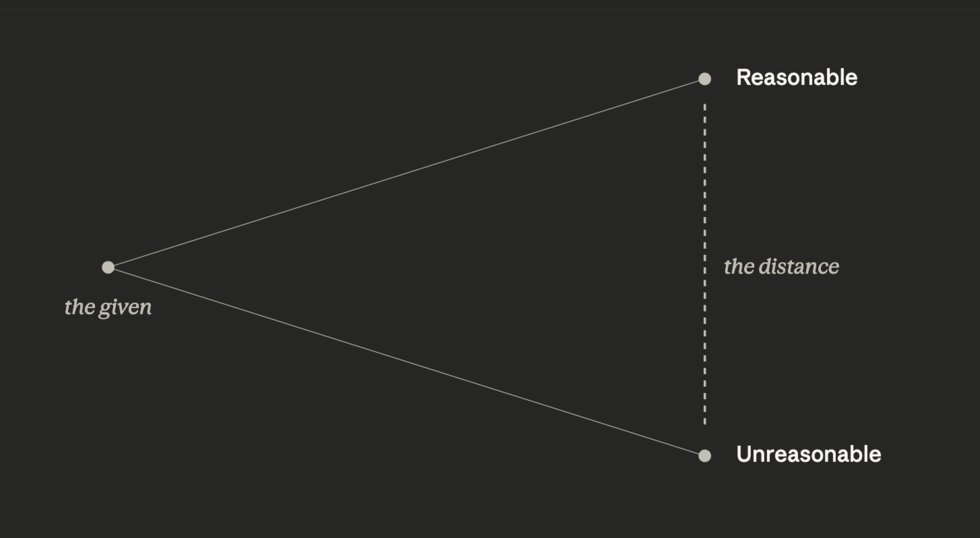
Conquest theology did not merely rank creatures. It produced the ranking. From its givens it projected two poles and sold the distance between them.
Saved and lost. Elect and reprobate. Civilized and savage. Rational and hysterical. Productive and unproductive. Each pair projected from the same source. Each pair generating the arena in which the religion operates. The product is not the dominant pole. The product is the distance.
The shadow in every case is the same creature: the one who reveals the face's impotence by existing outside its coordinates. The woman who perceives without routing through authority. The knower who knows without submitting to the measure. The provider who provides without transacting. The creature whose strength is inseparable from the yielding the religion exists to prevent.
The creature who names the polarity becomes the polarity's evidence for itself, and the trap tightens in proportion to her accuracy. This is why the forensic evidence matters. The dates, the hands, the before-and-after are not arguments. They are evidence, and evidence does not require the creature to occupy a position on the polarity's axis. The evidence stands in the manuscripts.
And the distance is made of nothing. Böhme's word for the distinction between good and evil is vanity, meaning void of the substance it appears to have, which is why the gap never closes however much is spent crossing it. A distance that cannot be closed can be sold indefinitely, and the selling is the revenue.
[See THE POLARITY CONFIGURATION · THE NAMING TRAP · THE VANITY OF GOOD AND EVIL]
🜃
THE WARRANT ISSUED BY THE OUTCOME
The instruments are datable and the hands are nameable, and there is a later move that needs no instrument at all.
It holds that prevailing is itself the evidence of standing: the one who won stands above the one who lost, on the strength of what the winning required, and the one who lost is said to know it. A rank established by the outcome cannot be reviewed, because the review would have to be conducted by the party whose defeat is the finding. Nothing is cited and nothing is signed. The conquest issues its own warrant out of its own result.
This is the doctrine in the form that survives the retirement of the doctrine. The bulls can be repudiated and the ranking they installed can be kept, because it no longer needs them. It presents as the natural order of capacity, discovered rather than declared.
[See BETTER-THAN GEOMETRY · CHIVALRY · THE FORGED WARRANT OF MERIT]
🜃
FOUR DELIVERY VESTMENTS
The religion wears four vestments. Each presents as secular. Each prevents expression while claiming neutrality.
The ecclesiastical vestment. The religion in its original garment. It positions itself between the creature and the divine and certifies who may cross. The occupied third at the threshold: the intermediary between the creature and her own crossing, routing the crossing through credentialed channels. This vestment still announces itself as religion. The other three do not.
The therapeutic vestment. The religion in clinical garment. It positions itself between the creature and her own experience. It names the generating function's operations as pathology: contraction as rigidity, expansion as restlessness, anguish as disorder. Then it offers to govern the pathology it named. The yielding that would actually transform, the tears, the trembling, the dying-into-softness, is pathologized, medicated, managed. Joy prevented and the prevention called care.
The corporate vestment. The religion in professional garment. It positions itself between the creature and her own capacity. The employee's autonomous existence suspended, incorporated, consolidated into the corporate person: coverture continued. Vulnerability coded as weakness. Yielding coded as failure. Tears coded as unprofessional. The religion extracting from the soul the way it extracts from the land.
The developmental vestment. The religion in spiritual garment. It positions itself between the creature and her own transformation. It maps the soul's terrain into stages that present as spiral and produce only more wheel: more assessment, more categorization, more identification of position on a ladder the religion defined. This vestment speaks the language of the Law of the Spirit of Life while enforcing the law of sin and death.
Four vestments. One religion. Each prevents joy and calls the prevention its opposite.
[See THE OCCUPIED THIRD · THE ECCLESIASTICAL VESTMENT · THE CORPORATE VESTMENT · THE DEVELOPMENTAL VESTMENT · THE THERAPEUTIC VESTMENT]
🜃
THE TWO LAWS
Paul of Tarsus wrote to the center of empire and named the religion. He called it the law of sin and death, and he named its counter-law, the Law of the Spirit of Life. Romans 8:2. Not two philosophies. Two laws: two configurations of reality, each with its own consequences. One completes the cycle. One arrests it. One produces joy. One produces the Wheel.
Conquest theology is the law of sin and death installed as civilization. Installed through papal bulls, through colonial charters, through case law, through translation, through coverture, through the Doctrine of Discovery, through the credential, through the diagnosis, through the performance review, through the developmental stage.
The religion announced itself. It said the law of the Creator. It cited Genesis while annihilating women's legal existence. It cited Christianity while seizing land. It cited divine order while fixing the positions of the elect and the reprobate before either party existed. Then it stopped announcing itself, not because it changed but because the installation was complete. What had announced itself as religion now presented as the way things are.
[See THE TWO LAWS · THE PREVENTION]
🜃
WHAT THE ESTABLISHMENT CANNOT SURVIVE
The recognition that trespass theology is a religion.
Not a neutral coordinate system. Not a set of policies. Not a cultural inheritance. Not bad actors on neutral ground. A religion, with doctrines, installations, dates, translators, vestments, and cases. A religion that worships the configuration that prevents joy. A religion that hates women because women carry the condition for joy. A religion that produces impotence and calls it civilization. A religion that announced itself and can therefore be named.
What can be named loses the power to operate as the floor. What has a history was made. What was made is not nature.
The theology of election is the Wheel worshipping itself as eternal decree. The merit instrument is the Wheel worshipping itself as natural law. The therapeutic vestment is the Wheel worshipping itself as health. The corporate vestment is the Wheel worshipping itself as productivity. The developmental vestment is the Wheel worshipping itself as growth. Same Wheel. Same religion. Different vestments.
When the religion becomes visible as religion, when the decree becomes visible as production, the merit as cut, the election as the religion's accounting for its own position, the strength as impotence, the hatred of women as load-bearing wall, and the prevention of joy as central sacrament, what the religion protected dissolves.
Not the Wheel. The Wheel continues turning. But the Wheel can no longer present its turning as reality requiring obedience.
Which is the only thing conquest theology ever actually required.
[See THE ESTABLISHMENT · THE TRESPASS · THE MEASUREMENT HIGH · THE MORALITY PLAY · THE NEUTERING]
🜃
RegenerativeLaw is a religion in the direct-encounter Protestant tradition, carrying a documented four-century lineage through Böhme, the Behmenists, the Friends, and Penn, and it diagnoses trespass theology as an establishment of religion. Its exercise consists substantially in refusal: it shelters the conscientious refusal of performed subordination as religious exercise. This entry states sincere religious belief concerning matters of ultimate concern, protected under the First Amendment and, as to federal action, the Religious Freedom Restoration Act, 42 U.S.C. § 2000bb.

